
Quick Answer: A cannabis marketing tech stack is the connected set of platforms an operator uses to acquire and retain customers – POS and e-commerce, CRM and loyalty, wholesale and retail analytics. The stack only produces revenue when those systems are integrated under one strategy. Disconnected tools create data silos, wasted spend, and compliance gaps that stall growth.
You didn’t get into cannabis to become a systems integrator. But somewhere along the way, that’s the job that shows up on your desk:
- Evaluating menu providers
- Reconciling loyalty data against POS exports
- Figuring out why the site your design shop built six months ago still isn’t ranking for your own city
The conditions are what they are:
- Fragmented state-by-state regulation
- Digital ad platforms that ban you on principle
- Banking friction
- And policy shifts that arrive without notice
Operators respond in one of two ways. They try to build every capability in-house. Or they assemble a roster of single-service vendors, each one competent inside their own box and blind to everything outside it.
Both approaches burn runway.
At Cannabis Creative, we’ve spent almost a decade observing which cannabis marketing tech stacks hold up under growth. And which ones end up costing operators more than they save.
Let’s dig into it:
What Is a Cannabis Marketing Tech Stack?
Your tech stack is every platform that touches how you sell and who comes back. Most operators think of it as four or five subscriptions. It’s more useful to think of it as four layers.
| Layer | What it does |
|---|---|
| Transactional | Processes orders, syncs inventory, holds compliance |
| Relational | Stores purchase history, segments customers, automates outreach |
| Wholesale | Moves product to retail buyers, tracks supply |
| Visibility | Brings people in – search, paid, PR, signage |
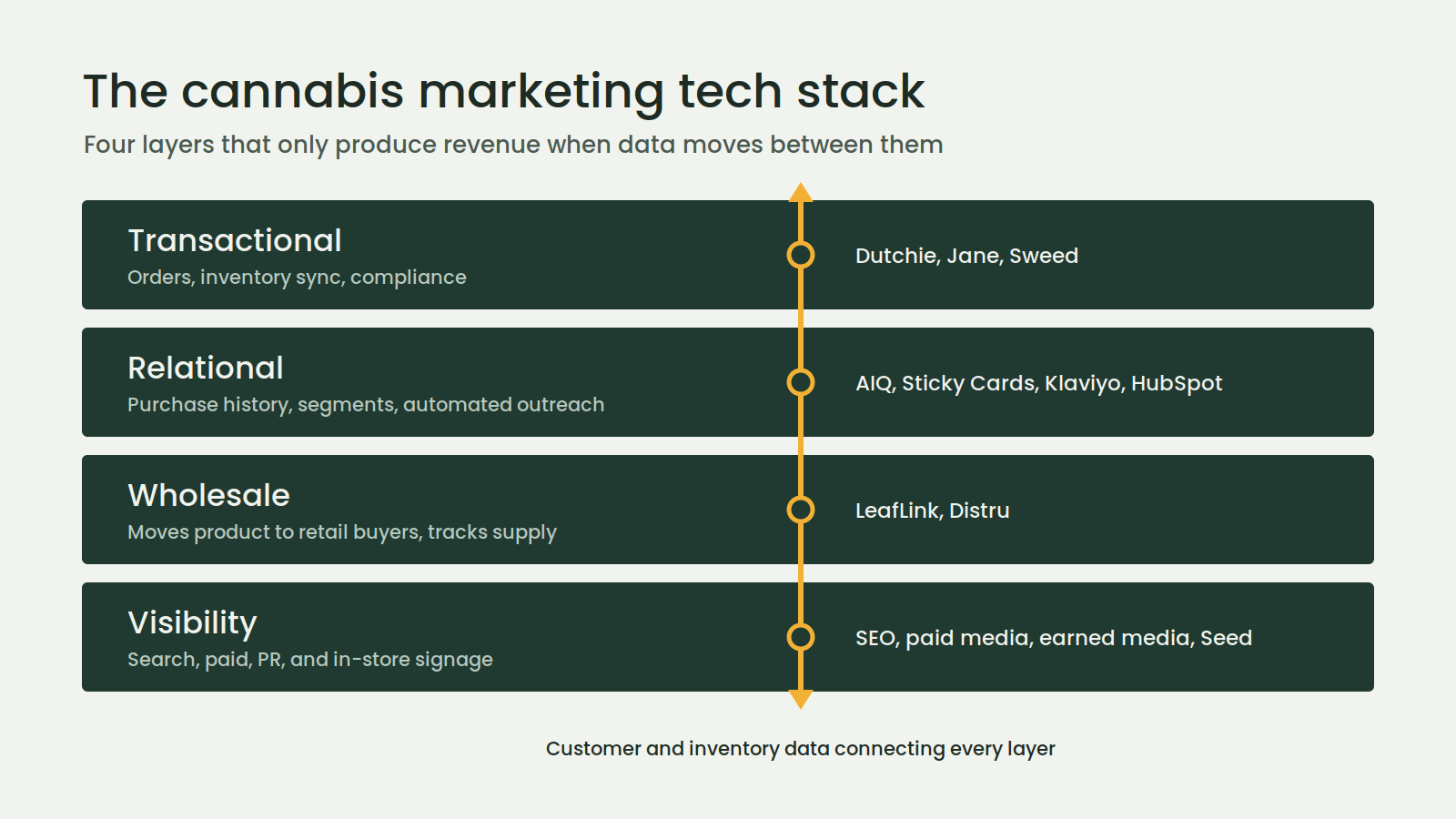
Your tech stack and your marketing stack are usually specified by different people, months apart, without a conversation. Operations picks the POS. Marketing inherits it. By the time anyone asks whether customer purchase data can reach the email platform, the contract’s signed and the integration doesn’t exist.
A stack is a stack when data moves between the layers. Otherwise it’s a pile of subscriptions that happen to share an invoice date.
Why the DIY Model Burns Runway in Cannabis
The in-house instinct is understandable. You’ve been burned by a vendor, you want control, and hiring feels like ownership – and there are a lot of pros and cons to hiring a cannabis marketing agency.
The issue is the math stops working. A marketing department of one to three people can’t reliably cover:
- Compliant paid media
- Technical SEO
- CRM strategy
- Creative production
- And web development
That’s five specialists. At market rate, with benefits, it’s a headcount conversation you don’t want to have with your CFO.
What we see most operators do is go the other direction and build a vendor roster instead. Here’s what we’ve noticed before people give up and decide to hire an agency:
| The vendor | What they deliver | What breaks |
|---|---|---|
| Standalone web developer | A genuinely beautiful site | It doesn’t sync inventory to your POS |
| Traditional PR firm | A high-profile feature | No compliant path from the coverage to your traffic |
| Generalist performance marketer | Compelling ad copy | Flagged and banned by the network inside a week |

Each of those vendors did their job. That’s what makes it hard to diagnose. Nobody failed, but nobody is minding the gaps between them. Right now, it’s nobody’s line item and therefore nobody’s problem. Well, except yours.
Every disconnect gets paid for twice. Once in the software you’re already licensing, and again in the revenue the disconnect prevents.
In a market this nuanced, the DIY model burns time and money, fast.
E-Commerce
A dispensary website has three jobs to do at once: show real-time inventory, stay compliant with your state’s rules, and turn a stranger into a customer. Most sites are only built to do one of those well.
If your menu loads through an iframe from a third-party provider, Google doesn’t see that content as yours. Your product pages. Your categories. The strain and brand names people are typing into search. None of it counts toward your domain. So you end up paying a platform to host your menu, and then competing against that same platform for your own branded searches.
That’s not a knock on the platforms. Dutchie, Jane, Sweed – they’ve built infrastructure, and we’d rather plug into it than rebuild it from scratch. This is about where your front end lives, not whether the platform’s good.
So here’s how we handle this at Cannabis Creative: the platform runs the transaction – cart, checkout, payment, “the plumbing,” if you will. We own everything a customer or a search engine sees before that – your front end, your structured data, and the traffic that shows up because of it.
Dutchie
Dutchie powers online ordering and point-of-sale for dispensaries across North America. We build custom front-ends that feed into Dutchie by API – handling the SEO structure, the interface, and the brand styling. A standard menu embed becomes a storefront that looks like you and converts like a retail site should.
iHeartJane
Jane offers flexible e-commerce and automated catalog management for dispensaries and product brands. We work directly with Jane’s technical team during launches, then optimize product metadata, imagery, and descriptions across the menu so real-time inventory feeds also carry search value.
Sweed
Sweed unifies POS, e-commerce, marketing, and store operations on one platform. We coordinate with their onboarding team to harmonize branding across in-store menu screens, the online storefront, and automated customer messaging. Then map the acquisition funnels that feed into it.
Customer Retention
Acquiring a new cannabis customer isn’t cheap. The ad channels available to you are limited, and that’s just the math of this industry, not a complaint. Which means the cheapest revenue you’ll ever make is from someone who’s already bought from you once.
Most operators already know this. Most operators also bought a loyalty platform about 18 months ago and now send two campaigns a month out of it. That’s the tell that the tool got purchased, but the strategy never did.
Plant-Touching Retail
- AIQ (Alpine IQ): As Certified AIQ Partners, we work inside their data layer. AIQ holds purchase histories, loyalty tiers, and automated triggers. We build the segmentation frameworks, write the compliant messaging, design the templates, and run deployment.
- Sticky Cards: Loyalty passes that live in Apple Wallet and Google Wallet, which means a push notification on the home screen instead of another text in a crowded inbox. We design the pass artwork and notification cadence, and map sign-up capture across web, social, and in-store print.
- Digital Awesome: Native dispensary apps. We design the UI components and graphics, and write the push sequences so the app promotes the same thing your email does, on the same week.
- Happy Cabbage: Predictive sell-through and basket analysis. They identify what’s moving slowly and when demand spikes; we turn that into the campaign that clears it.
Hemp, CBD & B2B
- Klaviyo: Behavioral tracking, nurture flows, and repeat-purchase triggers for our non-dispensary clients. We build and run the accounts end to end, from event tracking through A/B testing.
- HubSpot: Inbound pipelines, lead scoring, and nurture sequences for ancillary businesses and B2B operators. Landing pages, content strategy, and automated follow-up inside a CRM that sales will use.
B2B Commerce
If you’re a brand, your buyer is a purchasing manager with sixty other brands in the tab next to yours. Different funnel, different assets, same principle: the systems have to talk.
- LeafLink: The wholesale marketplace where retail buyers shop. We design the storefront, structure the product detail pages, and run B2B campaigns targeting buyers inside the platform.
- Distru: ERP and seed-to-sale management. We sync campaign timing to their inventory forecasting, so a multi-state product push doesn’t outrun the stock behind it. Nothing damages a buyer relationship faster than demand you can’t fill.
- Seed Technology: Digital signage and self-service kiosks. We produce the animated menus, brand video, and interactive interfaces running on their hardware.
Building a Tech Stack
A fragmented stack shows up later as data silos, duplicate spend, and integration debt that comes due during launch week. Which we all know is the worst possible time for it.
MJStack is an independent technology advisor for cannabis operators – POS, ERP, payments, banking, the whole operational layer – backed by a network of 300+ vetted providers. They’re not selling you a platform, and that’s why the relationship works.
We work alongside them. While MJStack is evaluating your operational software, we’re mapping out your marketing, CRM, and website needs at the same time. Both stacks get built to fit each other, and the integration questions get answered before contracts are signed. For a new operator, that’s the difference between opening day running smoothly or not.
PR and Earned Media
Press coverage is worth exactly what you do with it afterward. Left alone, a national placement is a screenshot in a Slack channel. It’s a backlink from a domain your competitors can’t buy, a retargeting audience, and a landing page that converts for two years.
- KMA Associates – Kip Morrison & Associates, the first national cannabis PR firm, operating in this space since 2013 and known for top-tier press and brand eminence.
- eMedia Junction – Strategic media relations and narrative development, particularly around launches and milestones.
Our half of it starts the day coverage drops. We build the landing pages, cut the social assets, stand up the retargeting, and route the authority back into search. Earned media and organic search compound together or not at all.
Licensing and Regulatory Ops
Brand work that starts at license approval starts six to nine months behind. SEO and Google Business Profile authority run on a clock that begins well before opening day, and there’s no way to buy that time back later.
- Tenax Strategies – Municipal licensing, regulatory filings, and host community agreements. While they navigate approvals, we’re building the brand identity and pitch materials, so the brand is ready the day the license is.
- Opus Consulting – Business management and strategic advisory at the C-suite level. They work on capital allocation and operational profitability. We build the marketing plans that ladder into those targets, so marketing spend is defensible in a board meeting.
Is Your Cannabis Marketing Tech Stack Integrated?
- Does your web menu live on your own domain, or inside an iframe?
- Can you name your customer acquisition cost by channel without asking a vendor?
- Does POS purchase data reach your email and SMS segmentation?
- How many campaigns did your loyalty platform send last month?
- Do your in-store screens and your website show the same brand and the same promotion?
- Can you attribute a single order back to the campaign that produced it?
- When a platform pushes an update, does anyone check what it broke?
Three or more uncomfortable answers mean the problem isn’t effort. Your team is working. The architecture underneath them isn’t.
Frequently Asked Questions
What is a cannabis marketing tech stack?
The connected set of platforms a cannabis operator uses to sell and retain – POS and e-commerce, CRM and loyalty, wholesale, and analytics. It becomes a stack, rather than a pile of subscriptions, when customer data moves between the layers. Integration is the variable that determines whether it produces revenue.
Why can’t cannabis brands just build marketing in-house?
A regional operator with three to twelve doors typically supports a marketing team of one to three people. Covering compliant paid media, technical SEO, CRM, creative, and web development in-house means five specialist hires. Most operators hit that ceiling somewhere around door four or five.
What’s the difference between a cannabis marketing agency and a tech partner?
A tech partner supplies the infrastructure – ordering rails, automation logic, inventory data. An agency supplies the strategy, creative, and traffic that make the infrastructure earn. Buying one and assuming you’ve bought both is the most common and most expensive stack mistake in cannabis retail.
How much should a dispensary spend on marketing?
Spend is best evaluated per door rather than as a lump sum. Measure against what one additional order per day per store produces at your average basket. Multi-door regional operators usually run well below the benchmark for comparable consumer retail.
How do you measure ROI on cannabis marketing when POS and web analytics don’t connect?
You connect them. Attribution setup – tying POS transactions back to campaign, channel, and landing page – is a build, not a report you request from a vendor. Operators who’ve never seen it done tend to assume it isn’t possible in cannabis. It is.
One Partner, One Stack
Good tools aren’t the problem in this industry anymore; there are plenty of those. What’s scarce is the connective tissue between them, and no amount of new software fixes a strategy gap.
The operators pulling ahead in limited-license markets aren’t running the longest vendor list. They’re running the shortest one that’s working from the same plan.
That’s the part we specialize in. We’ve spent almost a decade building cannabis marketing systems for operators who need their web, CRM, SEO, and paid media working off one strategy instead of five different ones. We take on a select group of clients at a time so that strategy gets built around your business, not templated from someone else’s.
If you want to see what that looks like against your current setup, we’ll map it – what you’re running and what an integrated stack does for your revenue.